- 20/04/2020
Locals foster the hope that the region will one day become a tourist destination with homestays, hotels, specialty foods and souvenir shops, following a new initiative from Dat Mui Commune to the provincial governments.
Mui (Cape) Village lies in the southernmost peninsula of Vietnam, 100 kilometers south of Ca Mau City. When visiting the southern region of Ca Mau, visitors usually tour Ca Mau Cape National Park (Mui Ca Mau) or stay at motels along Highway 1. But unknown to many is this unusual village inhabited by local Dat Mui in Ngoc Hien District, northeast of the national park.
A tall, curved bridge crosses the channel Vam Mui. Stilt houses elevated above the water line up one after another on either side of the river. At the same time, the area serves as a home for mollusk fishermen and a dock for small wooden vessels. Interestingly enough, no door collectively includes stilt houses.
Ba Ly, 66, who retired after two decades of fishing, recently took up the art of weaving a fishnet. Every day, while supervising his grandchildren frolicking in the yard, he weaves on the floor in a corner of the Room. As the sun shines in the afternoon on Ba Ly's porch, the rays in the metal wall panels seep through holes and fall on his cool forehead. His wife rest in a hammock in another corner.
A while later, Ba Ly beckons his grandkids to help him spread and test the net, after he's finished a file. A fishing net measures more than ten metres, which makes up about one-third of a house's length. The senior couple split the children into two classes, each holding one side of the net and stretching. Every corner of the house is filled with light, since the back of the house of Ba Ly is doorless.
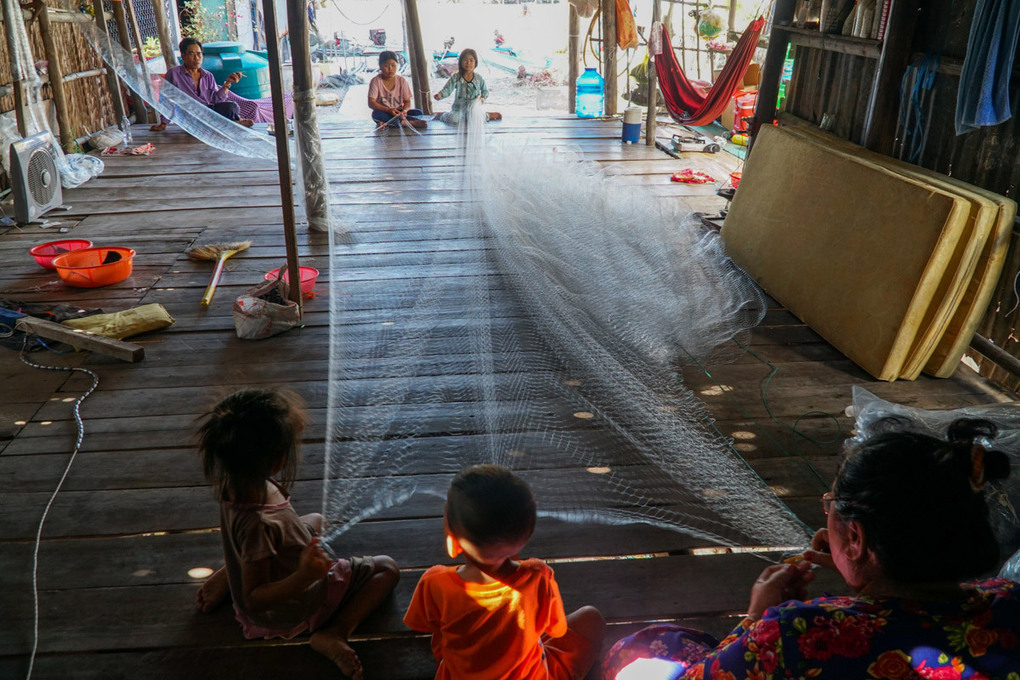
Ba Ly's family earns a living from spinning fishnet in their doorless home. Picture by Pham Linh / VnExpress.
Ba Ly is one of the senior local population of Mui Village. He remembers, there were just a few dozen houses in the village 30 years ago, set against a backdrop of brackish water and mangrove forests in the wilderness. He mainly sustained his generation on wildfish and forest crops. The doorless stilt houses tradition is a generational one, passed down from the days of his grandfather and family.
Ca Mau flourished at the end of the 19th century, when the French arrived, according to "A Tale of the Reclamation of the South," written by late cultural researcher and writer Son Nam. They arrived in Saigon sailing ships, without waiting. Some inhabitants of Cho Lon or Saigon's Chinatown have migrated to Ca Mau in the South to begin a new career.
"Houses were tucked away behind river streams on elevated plateaus while the estuary was a coastal body of brackish water, sand and grassy land plots. It was therefore difficult for these French to inspect from the main river," reads the book.
Maybe Mui Village remains the only place that still retains the tradition and characteristics of the stilt houses mentioned above.
Traditional Mui Village stilt houses typically have either three standards or two roofs, according to Ba Ly. Typically the walls are lined with coconut leaves while the house's floors, beams, and pillars are made of mangrove timber. The floor of the house rises from 1 to 1,5 m above sea level.
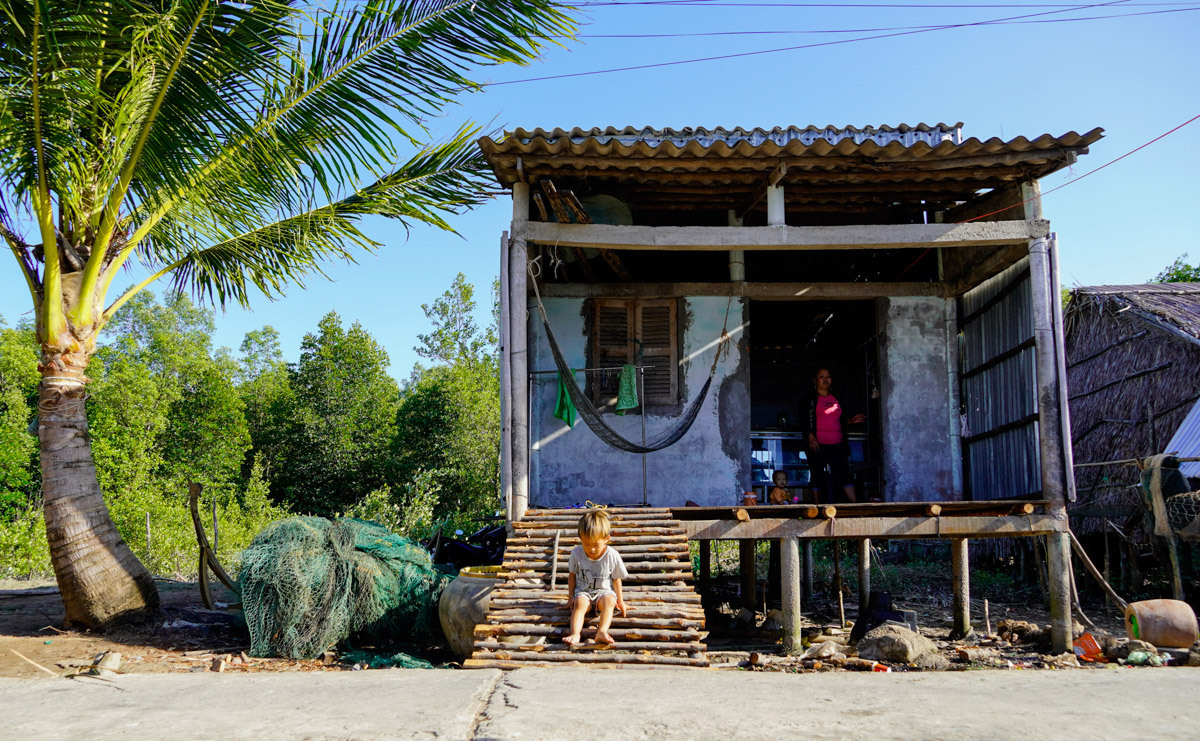
A stilt house in Mui Village, without doors. Picture by Hoang Nam / VnExpress.
Some newer houses nowadays have cement pillars and walls, as well as corrugated iron panels for a roof instead of coconut leaves. "The community was safe and protected before Highway 1 was constructed so there was no need to have doors," Ba Ly said.
Vo Van Xiu, 69, also known as Bay Xiu, Ba Ly's neighbor next door, is a war veteran who has received six decorations and orders. He was once assigned to enforce a program of de-densification of the population in Dat Mui. Bay Xiu talked a lot about his hometown's prosperity and fertile land which he believes has helped shape his positive, generous citizens.
In 1975 Bay Xiu recounted that he had returned from Can Tho City to Ca Mau, also in the Mekong Delta. At the time, when trudging through mangrove swamps, he could easily capture gobies and eetail catfish, and had to pay attention to crabs. As for the speciality of Dat Mui, the big mudskippers, "nobody bothered to catch them."
"We used to hack off 20-30-metre-tall mangroves in the forest to create houses. Some tree trunks were as wide as the three-person arm circle and it took a couple of days to cut down," said Bay Xiu.
Stilt houses in particular respond well to high tides as the sea level in Ca Mau rises regularly each year. Bay Xiu remembered that he ran a grocery store back when houses were made of wood and coconut leaf and put his items on the front porch. High tides will wash away his store's show by evening. "High tides generally occurred for three days in October and November, but we receded could not predict when they came," Bay Xiu said.
In 2010 Bay Xiu was offered help by the local administration to develop his home. He 'bargained': "I'll agree only if you let me build a stilt house." Bay Xiu removed wooden planks from his old house to create a new one after their agreement.
His new house is this time featuring a perron, window, and pillars all made of concrete. Now the roof and walls are made of wrought iron. However, the main modification is a metal sliding door at the end.
Vo Van Tung, 60, former head of Mui Village, said he wasn't born here but moved from Ca Mau Town some decades ago. "When I first arrived, the seniors here told me there used to be a lot of mosquitoes in the city. They had to continuously burn smoke under the houses to clear the mosquitoes. There were no doors in the houses so the mosquitoes could easily leave."
The stilt houses with no doors not merely evoke tranquility; they are reminiscent of times of reclamation. Farming and fishing companies aren't as profitable as they used to be despite a natural resource shortage. The prosperity and fertility described earlier by Bay Xiu appears to be absent in today's Mui Village.
Some positive cases however show otherwise, including Tu Cuong who bought land to build a motel and restaurant near the highway. Sometimes, he retreats to his Mui Village home.
Or after years of savings Nguyen Thi Nhan, a fish distributor, designed a cement home. Two decades ago, Nhan came to Mui Village to help her father with shrimp farming, and started her own business.
"Our family lived in a traditional doorless stilt house made of timber and leaves with only one room for my parents when we first arrived. Now we live comfortably in a two-bedroom home. With the nearby highway, we installed a door to avoid robberies," Nhan said.
Truong Van Se, vice president of the Dat Mui Commune People's Committee, said security in the region is stable thanks to the collective culture of the village, living habits and minimal traffic.
And the population has increased over the past two decades, as road networks grew. In 2000 Dat Mui Commune's entire population comprised just 2,000 households. The overall count has now risen to 3,400. Just Mui Village grew from 20 to 300 households.
Much of the population earn a living as fishermen. As the population rises, profit declines but luckily, income remains fairly steady and doorless stilt houses slowly change to comparable cement and steel.
"Since the national government is lobbying against the mining of forest protection areas, local people instead opt for steel, metal, cement and wood from the southeastern region when they select materials to build their homes," Se said.
To raise local tourism and reap benefits from the hundreds of thousands of tourists visiting the Mui Ca Mau National Park each year, Dat Mui Commune has proposed turning its residential area into a tourist attraction.
Many inhabitants of Mui Village are betting on the move. Vo Thanh Thung happily proclaimed during the interview that he has two grandchildren, one now in the bridge-side high school and the other in kindergarten.
He traverses the river every day to drop his grandchild off at 6 a.m. for kindergarten. Then, back at 4 p.m. To pick up. "This is good as long as we can keep them in school. And if we could grow tourism here, it would be great," Tung said.
Source : VnExpress International